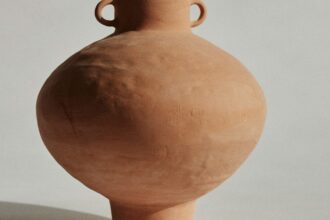
Polish Modernism. The Struggle for Beauty is not simply a design-history exhibition. It uses Polish modernism to tell a larger story about how artists and designers responded to war, scarcity, reconstruction, industry and the desire to become part of modern Europe. The exhibition premiered at Milan Design Week 2026 and attracted more than 18,000 visitors; the Warsaw version has been adapted specifically for Willa Gawrońskich.
The artists and designers
Katarzyna Kobro – probably one of the most important names to know. She was a pioneering Polish avant-garde sculptor whose abstract sculptures explored space, movement and the relationship between sculpture and architecture. Her work represents the radical, international side of Polish modernism.
Edward Krasiński – known for his minimalist, conceptual approach, particularly his use of the blue line running horizontally through space. His presence connects modernist ideas with post-war conceptual art.
Jerzy Nowosielski – one of Poland’s most important 20th-century artists. His distinctive combination of abstraction, icons, spirituality and geometric structure makes him particularly interesting in the context of an exhibition about the relationship between art and modern design.
Erna Rosenstein – a fascinating surrealist and experimental artist. Her work adds a very different dimension to the story of Polish modernism, showing that modernity wasn’t only about functional objects and geometric architecture.
Teresa Kruszewska – one of the most important Polish furniture designers. Her work is a great example of how modernism tried to combine function, ergonomics, new materials and elegant form.
Jan Kurzątkowski – an important pioneer of Polish furniture and interior design, particularly associated with the development of modern Polish design before and after WWII.
Roman Modzelewski – especially interesting for his experiments with fibreglass and innovative furniture forms. His work demonstrates how Polish designers could be highly experimental despite limited industrial resources.
Zbigniew Horbowy – a major Polish glass designer. His glass objects show how Polish modernism could be both industrially minded and highly artistic.
The exhibition also deliberately connects these historical figures with contemporary designers such as Tomek Rygalik, Maja Ganszyniec, Maria Jeglińska-Adamczewska, Agnieszka Bar and Monika Patuszyńska, showing that modernist ideas are still influencing Polish design today.
The most interesting idea is “beauty under conditions of scarcity.” Polish designers often had to work with whatever materials were available – wood, linen, hemp, fibre, industrial waste and experimental materials. Instead of seeing this simply as a limitation, they turned scarcity into a source of invention.
And the setting makes the exhibition stronger: the historic Willa Gawrońskich itself is placed in dialogue with modernism. A 1920s neo-Baroque villa becomes a contemporary exhibition space, while the objects inside challenge its historical interiors.