La Vie de Château at the Chateau de La Roche-Guyon, it’s a cultural and contemporary-art program running from 20 June to 1 November 2026. The château has invited artists to create site-specific installations, sound works, sculptures, exhibitions, and interactive experiences throughout the historic estate.
Highlights include:
Contemporary artworks integrated into the château’s historic spaces.
Sound installations exploring daily life at the château during the Enlightenment.
Family-friendly interactive exhibits and creative workshops.
Sculptural exhibitions in the château and its former orangery.
The chateau La Roche-Guyon itself is worth visiting even without the exhibition. Located in the village of La Roche-Guyon, about an hour from Paris, it combines a medieval keep carved into a chalk cliff, 18th-century salons, gardens, and wartime history.
Camille Chastang
Chastang’s exhibition Menus plaisirs is installed in the Pavillon d’Enville. She combines drawing and ceramics with strong floral and ornamental themes. For La Roche-Guyon, she also created a wallpaper piece called Femmage !, inspired by the Duchess of Enville and the château’s decorative history.
Yoshikazu Goulven Le Maître
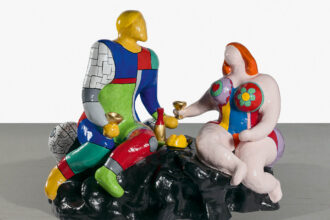
His exhibition Fauna Fabulosa fills parts of the château and the Orangerie with animal sculptures and imaginary creatures. The works blend fantasy, folklore, and a playful “punk-baroque” aesthetic. He also created Mirabilis, a cabinet of curiosities designed especially for the site.
Atelier Baptiste & Jaïna
This artist duo created Boutures minérales, a series of ceramic and blown-glass sculptures that appear to grow out of the château’s stone architecture, transforming the grand staircase into a suspended garden.
Atelier Blip Bloop
A sound-design collective behind Échos, an immersive audio installation in the 18th-century salons. Visitors hear poetic recreations of daily life at the château during the Enlightenment period.
Château de La Roche-Guyon
The Château de La Roche-Guyon, overlooking the Seine about an hour from Paris, has more than ten centuries of history. Its unusual architecture combines a medieval fortress carved into the chalk cliff with an elegant later château.
The earliest fortress was partly carved into the cliff, making it difficult to see from the outside. In the 12th–13th centuries, a powerful stone keep was built on top of the hill, connected to the manor below by a hidden passage.
Its strategic position overlooking the Seine made the château an important military stronghold. During the 15th century it was involved in the struggles between France and England.
Under the Duke of La Rochefoucauld and his daughter, the Duchess of Enville, the medieval fortress was transformed into a sophisticated residence (18th-century). New stables, terraces, wings and grand interiors were added, reflecting the Age of Enlightenment. Intellectuals including Turgot and Condorcet were associated with the château’s circle.
19th century: The château continued as an aristocratic residence and hosted literary figures such as Victor Hugo and Alphonse de Lamartine
World War II: In 1944, the German Field Marshal Erwin Rommel used La Roche-Guyon as a headquarters. Military installations and casemates were constructed within the cliff, giving the ancient fortress a new wartime role.
Today, The château is preserved as a historic monument and is particularly remarkable for the way its medieval keep, cliffside passages, Enlightenment architecture and WWII military remains coexist in one site.