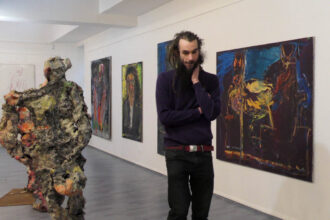
Genichiro Inokuma’s abstraction feels light, joyful, and spontaneous. Even when his work becomes fully abstract, it avoids heaviness. Lines float, colors breathe, and forms seem to move freely across the canvas, giving his paintings a sense of energy and optimism.
What makes Genichiro Inokuma unique is that his abstraction never feels cold or intellectual. It retains a human touch, a sense of joyful experimentation, a lifelong curiosity that continued into his 80s and 90s.
Genichiro Inokuma favored clear, bright colors—reds, blues, yellows, blacks, and whites. Colors are often applied in flat areas, creating a graphic, almost musical balance.
His abstract works often have an open, airy space. The canvas is not crowded, instead, elements are carefully placed to create balance through emptiness. This reflects a subtle connection to Japanese aesthetics, where space is as important as form.
Unlike many postwar abstract artists who focused on tension or anxiety, Inokuma’s abstraction expresses: freedom, curiosity, childlike imagination. There is a sense of drawing “without fear,” as if exploration itself is the goal.
Genichiro Inokuma (猪熊弦一郎, Inokuma Gen’ichirō / born 1902 Kagawa Japan / died 1993 in Tokyo) was a renowned Japanese modern artist and painter, celebrated for a career that spanned more than 70 years and bridged Japanese and international modernism.
Trained at Tokyo Fine Arts School (now Tokyo University of the Arts). Since late 1930s he lived and worked in Paris, where he was influenced by European modernism and Henri Matisse.
In 1955, he moved to New York spending about 20 years there; this period marked a strong shift toward abstract expression inspired by urban life and architecture.